


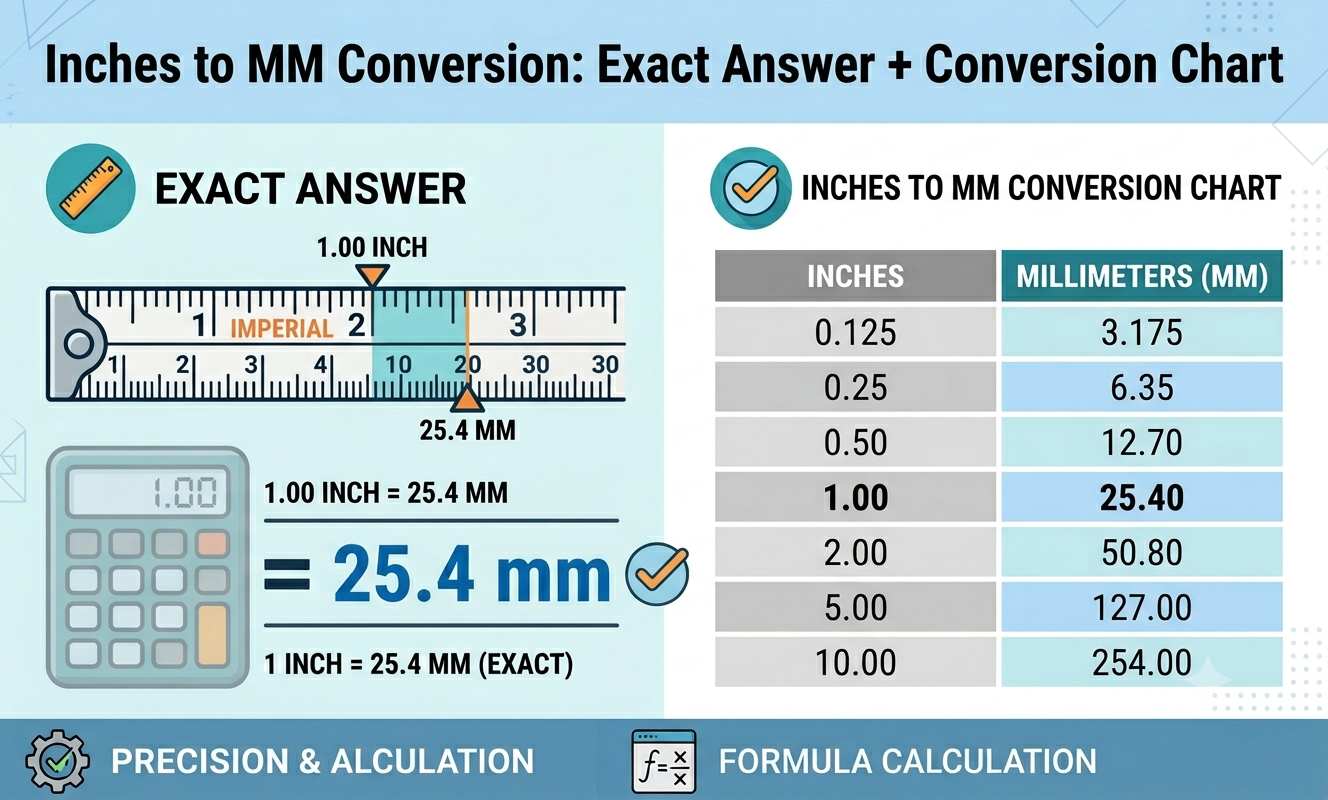
Direct Answer
1 inch = 25.4 millimeters
To convert inches to mm, multiply the inch value by 25.4. This is the internationally standardized conversion factor used in engineering, manufacturing, and everyday measurement.
What is Inches to MM Conversion?
Inches and millimeters are both units of length, but they belong to different measurement systems. Inches are used in the US customary system, while millimeters are part of the metric system used globally.
When you need to convert inches to mm, you simply multiply by 25.4. For example, a smartphone screen listed as 6 inches is 152.4 mm wide — a measurement format commonly used in technical specs across Europe and Asia.
This conversion is essential for anyone working across imperial and metric systems daily.
Formula to Convert Inches to MM
The formula is straightforward:
Millimeters = Inches × 25.4
For the core keyword conversion:
1 × 25.4 = 25.4 mm
Two more examples:
- 5 inches × 25.4 = 127 mm
- 12 inches × 25.4 = 304.8 mm
Always multiply — never divide — when going from inches to mm.
Inches to MM Conversion Chart
| Inches | Millimeters (mm) |
|---|---|
| 0.5 | 12.7 |
| 1 | 25.4 |
| 1.5 | 38.1 |
| 2 | 50.8 |
| 3 | 76.2 |
| 4 | 101.6 |
| 5 | 127.0 |
| 6 | 152.4 |
| 8 | 203.2 |
| 10 | 254.0 |
| 12 | 304.8 |
| 24 | 609.6 |
All values calculated using the standard formula: Inches × 25.4 = mm.
Common Uses of This Conversion
1. Engineering and Manufacturing
Technical drawings and blueprints in the US often list dimensions in inches. When sharing these internationally, engineers convert inches to mm to meet metric standards. A bolt listed as 0.5 inches, for instance, translates to 12.7 mm — a critical precision detail.
2. Screen and Display Sizes
TV and monitor sizes are advertised in inches in most markets, but hardware specs list bezels, ports, and panel thickness in millimeters. A 55-inch TV diagonal is 1,397 mm — useful when calculating shelf or mount dimensions precisely.
3. Sewing, Tailoring, and Fabric
Pattern measurements in inches must often be converted to mm for European sewing patterns or precision cutting machines. A seam allowance of 0.25 inches equals 6.35 mm, which most industrial cutting machines require in metric format.
Frequently Asked Questions
Q1: What is inches to mm conversion?
Inches to mm conversion is the process of changing a measurement from inches (imperial) to millimeters (metric) by multiplying the inch value by 25.4. This is the exact, universally accepted conversion factor defined by the International Yard and Pound Agreement of 1959.
Q2: How do I convert inches to mm?
The formula is simple: multiply your inch value by 25.4. For example, 3 inches × 25.4 = 76.2 mm. No division is needed — just one multiplication step gives you the precise millimeter equivalent every time.
Q3: How many mm is 6 inches?
6 inches × 25.4 = 152.4 mm. This is a commonly searched conversion because 6 inches is a standard small ruler length and also a typical smartphone screen diagonal size in many markets.
Q4: Why do engineers prefer mm over inches?
Millimeters offer finer precision without using decimals as frequently. Instead of writing 0.25 inches, an engineer writes 6.35 mm — a whole number that’s easier to read on a technical drawing and less prone to misinterpretation on the shop floor.
Q5: Is 1 inch big or small?
1 inch (25.4 mm) is roughly the width of a standard adult thumb at the knuckle. It’s also close to the diameter of a US quarter coin. In everyday terms, it’s a small but very practical unit — the width of a USB port is about 12 mm, just under half an inch.
Use this inches to mm conversion guide whenever you need a quick, accurate reference for engineering specs, product dimensions, or international measurements.
